Showing posts with label potholes. Show all posts

Friday, 1 February 2019

NEWS: POTHOLE REPAIRS AND COMPENSATION PAYMENTS SOAR

POTHOLE REPAIRS AND COMPENSATION PAYMENTS SOAR

POTHOLE REPAIRS AND COMPENSATION PAYMENTS SOAR


Highways England repaired 22,862 potholes last year, up from 14,104 in 2017, and the compensation bill soared from £81,500 in 2017 to £329,379 in 2018.

The definition of a pothole varies depending on where you live.

Britain’s roads are maintained by a network of 207 local highways authorities (LHA), each with its own budget, problems and priorities, and each allowed to come up with its own set of rules that defines when a road defect becomes a pothole that needs fixing. And even once a pothole reaches that critical threshold there’s an equally diverse set of response times and reactions. The overall result is that a pothole that gets fixed within hours on one stretch of road might be left for much longer – or allowed to get worse – if it was just a few yards away, across the boundary into another LHA’s territory.

The vast variation between different areas is highlighted by a set of Freedom of Information (FoI) requests sent out by the RAC Foundation late last year. Of the 207 authorities, 190 provided enough data for the RAC Foundation to pull together a comprehensive comparison of the varying thresholds and response times around the country.

The results show that, encouragingly, most (75%) of the LHAs now adopt a ‘risk-based approach’ to fixing potholes. That means rather than ticking specific boxes about pothole dimensions before triggering a repair, LHAs assess the potential dangers, both to people and vehicles, and base their decisions to fix holes on those risks. However, most still have dimensional thresholds that the potholes must exceed before they even enter the risk-assessment phase, and there’s a wide disparity of those thresholds across the nation.

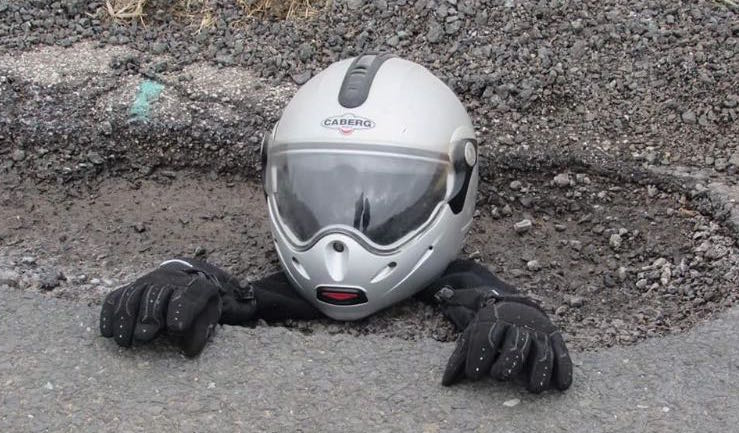
The RAC’s FoI revealed that in some parts of the country (12 LHAs) there’s no specific threshold, and any reported road damage will automatically be risk-assessed. In another 37 LHA, small potholes between 20mm to 30mm deep would get assessed, while at the other end of the scale there were 26 LHAs that won’t even initiated a risk-assessment, let alone a repair, until the hole is more than 50mm in depth. For car drivers, that could be the difference between an uncomfortable thump and a puncture or dented wheel rim. For motorcyclists the stakes are rather higher.

Even the chance of a pothole being recorded in the first place varies from place to place. Although there is a Code of Practice for LHAs that recommends checking primary and secondary roads once a month, link roads once every three months and local roads once a year, only 28% of LHAs actually follow that guidance. In all, the RAC Foundation discovered there are 109 different inspection frequencies used between the 190 authorities that responded to its investigation. As well as these inspections, authorities will also check on potholes reported by the public; so if you see or hit a pothole that looks like it poses a danger, it’s worth reporting it as it could be weeks or months before the next scheduled check on any particular piece of road.

Even once a pothole has reached the threshold of size required for a risk-assessment, there’s a wide variation in response times depending on the LHA area that it falls within and the results of that assessment. But even then, there’s still a broad spread of responses.

In some areas, potholes assessed to be in the worst category will be fixed ‘immediately’, with 8% aiming to be on the case within an hour for the most dangerous holes and 42% aiming at a two-hour limit. But here the postcode lottery for potholes is clear once again – in Harrow, for instance, the worst holes will be fixed within 30 minutes, while in Coventry the target time for fixing holes of the same class is five days.

Reactions to less severe potholes are similarly diverse, with 18% of LHAs aiming to fix the least-urgent ones within 28 days, while 25% will leave it until the next ‘programmed works’ on that stretch of road and 13% will simply monitor the hole, leaving repairs until it gets bad enough to slide into a riskier category.

Away from LHA roads, potholes are also an increasing problem on motorways and strategic roads operated nationwide by Highways England. A Freedom of Information inquiry in December revealed that Highways England repaired 22,862 potholes in 2018, up from 14,104 in 2017. It also showed that the amount of compensation paid following damage report claims rose spectacularly, from £81,500 in 2017 to £329,379.


The best motorcycle industry news at www.britishdealernews.co.uk

Thursday, 6 November 2014

NEWS: MCN launches Save Our Roads Petition

MCN is launching a Save Our Roads petition today to encourage the Government to implement a proper plan to improve them.


British Dealer News is the best place for motorcycle industry news

MCN claims:

• The Government raises £33bn through tax on petrol each year, yet none of this revenue is allocated to road maintenance.

• 18 per cent of Britain’s roads are classed as being in poor condition.

• 70 per cent of people are dissatisfied with the state of UK roads.

MCN points out that the road network is Britain’s most valuable asset (Action For Roads report, DfT 2013), yet we currently spend less than one per cent of its asset value maintaining it.

MCN has a three-point plan:


1. 2p from the 57.95p that the Government takes from every litre of fuel should go to preventative road maintenance. This guaranteed income of around £1bn would allow highways authorities to plan maintenance properly. 

2. The Government’s Code of Practice for road maintenance should be rewritten for 21st-century traffic conditions and budget constraints.

3. All road authorities should have a competent Asset Management Plan, forcing them to think long-term about road maintenance.

The MCN Save Our Roads Petition encourages motorcyclists to send out a message to the Government that it can no longer ignore the danger to motorcyclists caused by potholes and deteriorating road surfaces.

The petition can be found at www.motorcyclenews.com/saveourroads


In the motorcycle / related trades? Register for free motorcycle industry news @ www.britishdealernews.co.uk

Thursday, 14 March 2013

SKY NEWS REPORT ON POTHOLES


Interesting feature on shabby roads and potholes on Sky News this morning! Here it is in case you missed it:

The road survey carried out by the Asphalt Industry Alliance (AIA) has found one in five local roads is in "poor condition", which is defined as having five years or less life remaining.


Potholes- getting worse?

Lack of funding for road repair work is blamed by the group, with local authorities in England reporting a shortfall in their annual budgets of £829m.

Rosemarie Dutton broke her leg after tripping up on a pothole while crossing the road in Middlewich, Cheshire, last month.

She told Sky News: "I was checking on the lights that they weren't going to change on me and before I knew it I was down on the floor due to one of the large potholes on the pedestrian crossing. "Obviously I was in excruciating pain and no-one came to help me - I was amazed."

Mark Morris' son wrote off his car after he hit a pothole and lost control of the vehicle. He told Sky News: "He hit a pothole which appears to have disconnected the steering of the car. "As he came down the hill and turned into the bend his steering just hasn't been engaged with the wheel - and the wheel's turned left straight into a lamp post."

The Local Government Association (LGA) is calling on Whitehall to free up money and invest it in resurfacing roads.

Councillor Peter Box, the chairman of the LGA, said: "Keeping roads safe is one of the most important jobs councils do and over the past two years they have fixed almost four million potholes - one every 16 seconds.


Potholes: not good for bikers
"Almost half a billion pounds is being taken away from us and our general fund is being reduced by some 30%. "Now something has to give. It's no good anyone saying 'well, actually, you should be doing this despite the fact that your budget's being cut'."

But the AIA report says there is a mounting cost to councils of not repairing roads. Last year £32m was paid out in road user compensation claims.

It is estimated that poorly maintained roads are costing small and medium-sized businesses £5bn a year in reduced productivity, increased fuel consumption, damage to vehicles and delayed deliveries. 

Andy Jennings runs a taxi firm in Sandbach and has recently had to spend £400 repairing the suspension on two of his vehicles.

He told Sky News: "Obviously we can't afford to do this at the moment. In times of recession every penny counts."

Local Transport Minister Norman Baker said: "We are providing councils with more than £3bn between 2011 and 2015 to maintain their roads and pavements.

"In December 2012 we announced an extra £215m to help councils get the best out of their road network.  This is on top of the additional £200m we gave to councils in March 2011 to repair local roads damaged by the severe winter weather in 2010.

"It is ultimately up to local highway authorities to determine how they prioritise their funding, but we want to help them get the best value for money.

"That is why we are funding the Highways Maintenance Efficiency Programme, which helps councils work together to deliver a first-class service to their residents, at the same time as saving money." 

I'm sure we all agree that potholes are a growing problem and need addressing!

In the motorcycle / related trades? why not register for FREE with us at www.britishdealernews.co.uk